
Criteria Management Ltd
"We just want to steal your money"
You thought he would IPO?

Criteria Management was sold as another big Stephen Brown opportunity, complete with a supposed path to a public listing. Instead, it never traded, recycled familiar HPIL-era projects, and later became a Brown-owned related party receiving hundreds of thousands of dollars from FTI. By 2026, Criteria was facing unpaid rent claims, its lease had been terminated, and the company was dissolved.
The Fake IPO That Eventually Became FTI’s Related-Party Expense Account
Criteria Management started with the usual Stephen Brown formula: take a collection of old ideas, give them a new corporate wrapper, announce big plans, surround the company with familiar investors and promoters, and tell everyone the public-market payday is right around the corner.
Then, when the public company never happened, Criteria found a new purpose.
Years later, FTI Foodtech’s own amended regulatory filings would identify Criteria as 100% owned by Stephen Brown, disclose hundreds of thousands of dollars in transactions involving Criteria, and state something almost comically revealing: Criteria had “no other business” and existed solely to support its agreements with FTI.
Quite the evolution for the company that investors were once told was headed to Nasdaq.
In April 2023, Brown proudly announced that he was now Chairman and CEO of Criteria Management Ltd.
Because apparently the problem with the previous ventures was the logo.

Riz Alikhan similarly announced that he was joining Criteria as CFO, while familiar Brown associates congratulated the new venture. Criteria was presented as a real operating company with management, projects, shareholders and, most importantly, an imminent public listing. (Oh look, a Mark Osborne sighting!)

And many of the names surrounding Criteria were not exactly new. (Oh look, another Mark Osborne sighting!)
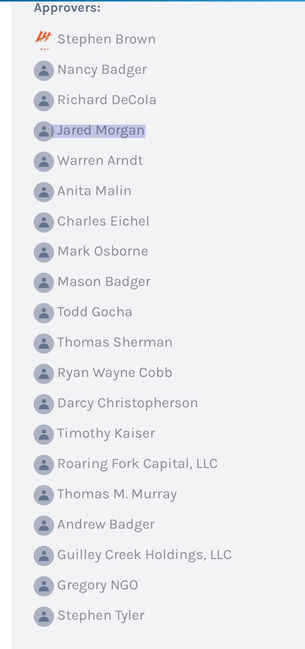
Criteria's materials included a collection of people already familiar from the HPIL universe. Mark Osborne, Andrew Badger, Ryan Cobb, Darcy Christopherson and others appear alongside Brown.
New company. Familiar cast.
THE AMAZINGLY FAST NASDAQ IPO
This was the really impressive part.
According to materials circulated to Criteria investors, Brown was not merely considering taking Criteria public. Investors were being given actual trading dates (fabricated by Stephen).
A March 14, 2023 fabricated Nasdaq email concerned a symbol reservation request for “CRME.” But the underlying correspondence did not establish that Criteria had been approved for listing or authorized to begin trading. Nasdaq later expressly notes that the email reflected a symbol-reservation process, not Nasdaq listing approval. (Here he is again, another Mark Osborne sighting!)

That minor distinction apparently did not interfere with the sales pitch. Investors were subsequently told Criteria would trade on April 10, 2023, and a Zoom meeting was organized around the supposed launch. Criteria never traded. (Here he is again, yet another Mark Osborne sighting...)

So, to summarize the Criteria IPO:
-
Symbol request = not submitted.
-
Nasdaq listing = no.
-
Trading date = announced anyway.
-
Actual trading = never happened.
For most companies, “when do we actually qualify to list?” comes before “tell investors the trading date.”
Stephen apparently preferred the more entrepreneurial sequence.
SAME PROJECTS, DIFFERENT BOX
Criteria also looked suspiciously familiar because much of what was being presented wasn't particularly new.
Projects and concepts that had previously been promoted through HPIL began appearing under Criteria and other Brown-controlled private entities. The original Criteria page documented, among other things, the migration of the HUMM Token concept and the recycling of ventures that had previously been pitched under HPIL. The current site itself preserves that history.
That matters because HPIL shareholders had already been sold the vision.
They had already been told about projects.
They had already been told about funding.
They had already been told about acquisitions and deals.
They had already bought the stock.
HPIL itself eventually issued a 2022 notice correcting or clarifying multiple earlier announcements involving acquisitions, financing, FINRA processing and the Apogee project.
And then some of the ideas simply seemed to acquire new corporate homes.
The technology didn't need to work.
The funding didn't need to appear.
Apparently the important thing was making sure the PowerPoint survived.
THEN CRITERIA BECAME A STEPHEN BROWN COMPANY
Here is where the story gets considerably more interesting.
Years after Criteria had been presented to a group of shareholders as the next public venture, court materials concerning Brown's finances describe something very different.
A filing in the British Columbia litigation states that Brown was the founder, sole director and sole shareholder of Criteria Management Ltd. It further states that Brown acknowledged having complete control of Criteria's banking and that Criteria's money supported his living expenses.
The same filing reports approximately $3.758 million in deposits into Criteria's account between September 2021 and early February 2025. Those are gross deposits, not profit or income, and the statements are allegations contained in an adversarial court filing rather than a judicial finding.

In later filings by FTI, Brown explicitly states Criteria was a wholly owned company of his.
This disclosure did not simply appear because FTI and Brown suddenly developed an enthusiasm for transparency.
FTI publicly announced in January 2026 that it was refiling its financial statements and MD&A following a continuous-disclosure review by the British Columbia Securities Commission, specifically adding disclosure concerning transactions between FTI, Brown, Criteria and Portofino.
In other words, the Brown-controlled entities that had been receiving FTI money eventually received considerably more attention in the filings.
Funny how regulatory reviews can improve one's memory.
$460,968: THE MONEY THAT NEEDED A BETTER DESCRIPTION
FTI's amended June 30, 2025 disclosure is remarkable.
The company reported that it had advanced $460,968 to Brown-related entities, which was subsequently reclassified into expenses including office costs, rent, insurance, marketing, and legal and audit fees.
The amended filing then broke out transactions involving Criteria.

Not bad for what FTI itself later described as a company with “no other business.”
YES, FTI ACTUALLY SAID THAT
This may be my favorite part.
FTI's amended MD&A explains why Criteria and Portofino were still around:
the companies were allegedly needed because FTI itself did not have sufficient credit to qualify for the office leases. And then FTI disclosed this:
“These two companies have no other business and solely are functioning to support the agreements with FTI.”
Read that again. Criteria went from:
-
Future public company.
-
Nasdaq symbol CRME.
-
Management team.
-
Investors.
-
Projects.
-
Trading date.
to:
-
100% Stephen Brown owned company with “no other business” except receiving reimbursements from another public company Stephen Brown happened to run.
That is not exactly the Nasdaq success story Criteria investors were sold.
THE FIVE-YEAR LEASE
The underlying lease documentation also deserves its own section.
Criteria's sublease shows a term beginning February 1, 2021 and ending January 31, 2026, with monthly basic rent of approximately $15,671, plus storage and other occupancy costs.
That matters because FTI's later explanation for sending money through Criteria rested heavily on these leases. FTI said Brown's companies had existing five-year leases, that FTI occupied the premises, and that the public company therefore reimbursed Brown's private companies for the associated costs.
So the flow was remarkably convenient:
-
Brown owns Criteria.
-
Criteria holds the lease.
-
Brown becomes CEO of FTI.
-
FTI says it cannot qualify for its own lease.
-
FTI occupies the space.
-
FTI sends money to Brown-controlled Criteria.
-
FTI initially reports the transactions one way.
-
A BCSC disclosure review happens.
-
FTI amends the filings and provides substantially more information about where the money went.
Nothing complicated about that.
The office story gets even better. While FTI was reporting rent expense through Brown-owned Criteria, Criteria itself allegedly fell behind on the underlying premises and lost the office. So FTI shareholders were being charged rent through Brown's private related-party company while that private company allegedly was not keeping the actual landlord current. Shortly afterward, Criteria was dissolved.

AND THEN CRITERIA DISAPPEARED
Criteria never completed the public listing investors were told was coming. The court materials state that Criteria never traded and was ultimately dissolved in 2026. Which creates a rather incredible timeline:
-
Criteria was promoted as a future Nasdaq company.
-
The Nasdaq listing never happened.
-
Brown eventually became its sole shareholder.
-
Criteria later became a related-party conduit for expenses of a public company Brown controlled.
-
FTI's disclosure of those transactions had to be expanded after a securities-regulator review.
-
Hundreds of thousands of dollars in FTI expenses were attributed to Criteria.
-
And then Criteria was shut down.
A beautiful corporate lifecycle.
Just not necessarily the one investors were shown in the pitch deck.

CRITERIA - VEHICLE TO FUND STEPHEN BROWN'S LAVISH LIFECYCLE
What is really going on here then? What is the point of all this... well Stephen admitted it in the Rakesh lawsuit: TO FUND HIS LAVISH LIFESTYLE
According to a filing in the Rakesh Dhunna litigation, Brown acknowledged that he had complete control over Criteria’s banking and that Criteria’s money supported his living expenses. The same filing describes Brown as Criteria’s founder, sole director and sole shareholder, and reports roughly $3.76 million in deposits into Criteria’s account between September 2021 and early February 2025. Those figures are deposits, not profits or personal income, but the admission about how the money was being used is the important part.
In other words, while investors were being sold Criteria as a legitimate operating company with projects, management and even a supposed path to a public listing, Brown was simultaneously controlling the bank account and using Criteria funds to support his own living expenses.
That makes the later FTI transactions even more revealing. Criteria did not become some independent success story. It became a Brown-controlled related party receiving money from another public company he ran.
The pitch was “Criteria Management.” The reality, by Brown’s own admission, was much simpler:
Criteria’s money was Stephen Brown's money, just like every other scam Stephen runs.

THE CRITERIA MANAGEMENT BUSINESS MODEL
If you strip away the presentations, titles and LinkedIn congratulations, Criteria's history is surprisingly easy to summarize:
Step 1: Repackage projects previously promoted elsewhere.
Step 2: Recruit familiar investors and associates.
Step 3: Tell them a public listing is coming.
Step 4: Circulate a trading date before there is an actual listing.
Step 5: Never trade.
Step 6: Eventually consolidate the company under Brown's ownership and control.
Step 7: Use the entity in related-party transactions with another Brown-run public company.
Step 8: Provide fuller disclosure only after regulators start asking questions.
Step 9: Dissolve Criteria.
Criteria Management never became the Nasdaq company investors were promised.
But it did eventually accomplish something.
It became very good at funding Stephen's lavish lifestyle.

Stephen Brown
King Douchebag
Over 40 years of stealing other people's money and running from the police. Now trying to steal money through Criteria Management Ltd... because he is a douchebag.
604-558-2515

After getting caught trying to defraud potential investors with a fake Spyker Car deal under Retrospect Auto, Stephen Brown changed the name to Interworld Boing Agency LTD. Now he is trying Criteria Management scam. He can't stop being a douche.


Stole HUMM Token from HPIL
HUMM Token is an HPIL asset that Stephen Brown has stolen from shareholders and moved into this new private corporation, with a few select HPIL shareholders. Even though, he issued shares in HPIL for this asset to him and a few people he owed money to...
